Legal accounting software

Accounting built for client money compliance

Manage matter ledgers, bank accounts, reconciliations and compliance records in one connected system. Superlawyer brings the shared controls together, with support for requirements set by the SRA, CLC and CILEx Regulation. Compliance stays your firm's responsibility - Superlawyer makes it easier to operate and evidence.

  • Manage office, client, deposit and designated deposit accounts
  • Prepare and sign off three-way client account reconciliations
  • Separate who requests a payment from who approves it
  • Maintain breach, residual balance, VAT and audit records

Three-way

Reconciliation with permanent sign-off

SRA, CLC, CILEx

Regulator-specific rules on shared controls

Xero

VAT and MTD exports coming soon

How it works in practice

Follow financial activity from an individual matter into the firm-wide cash books, ledgers, reconciliations and compliance reports, without losing the context behind a transaction.

Matter ledgers

See every balance and transaction in the context of the matter

Bring receipts, payments, disbursements and recharges into one matter ledger. Office, client and deposit money remain clearly separated, while combined and account-specific views help fee earners and cashiers understand the complete financial position.

  • Combined or separate office, client and deposit views
  • Matter-linked receipts, payments, disbursements and recharges
  • Clear running balances and unbilled items
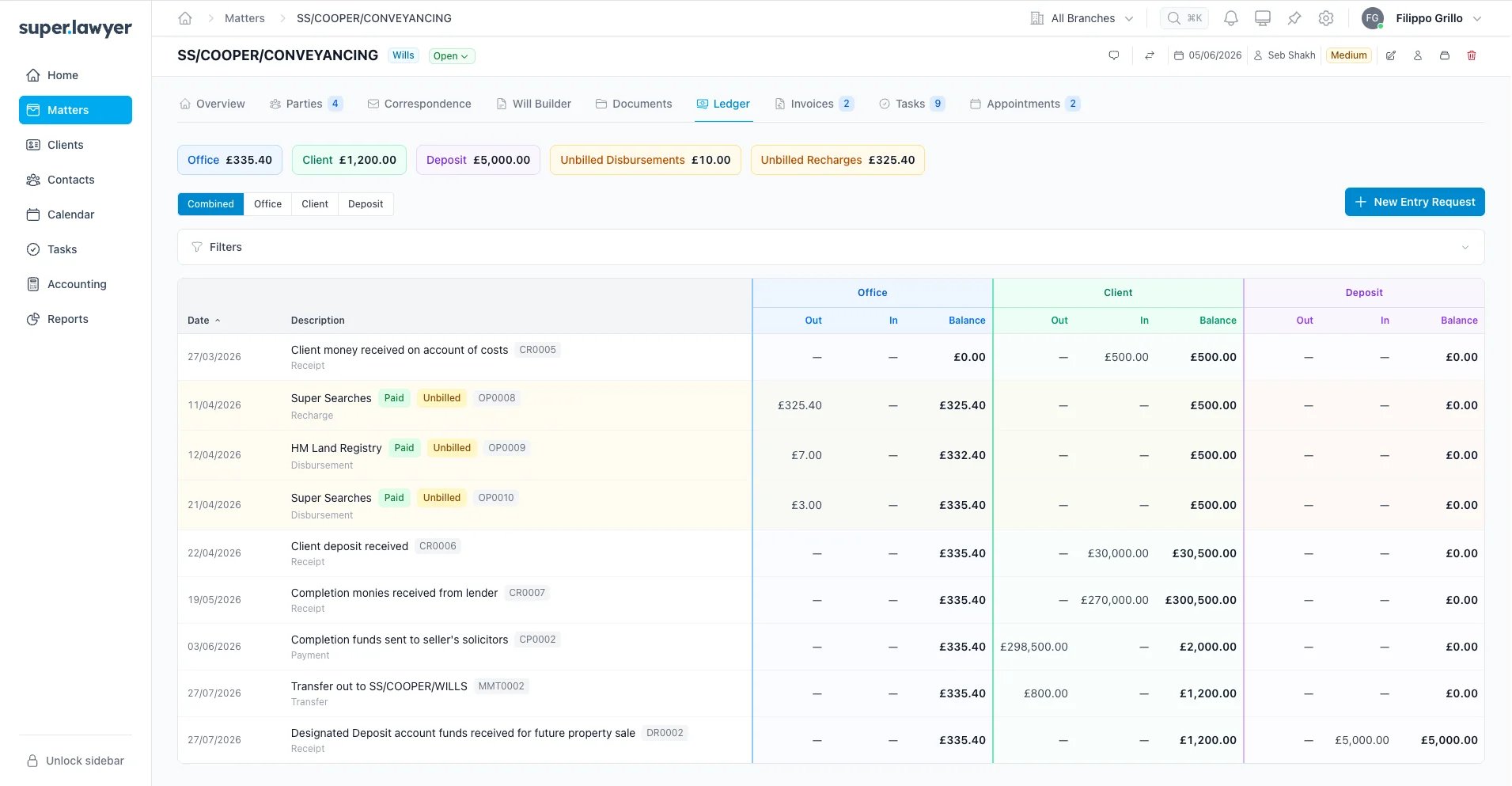
A busy Superlawyer matter ledger showing office, client and deposit balances alongside receipts, payments, disbursements and recharges
Office, client and deposit activity visible together on the matter

Bank accounts and cash books

Keep office, client and deposit money firmly apart

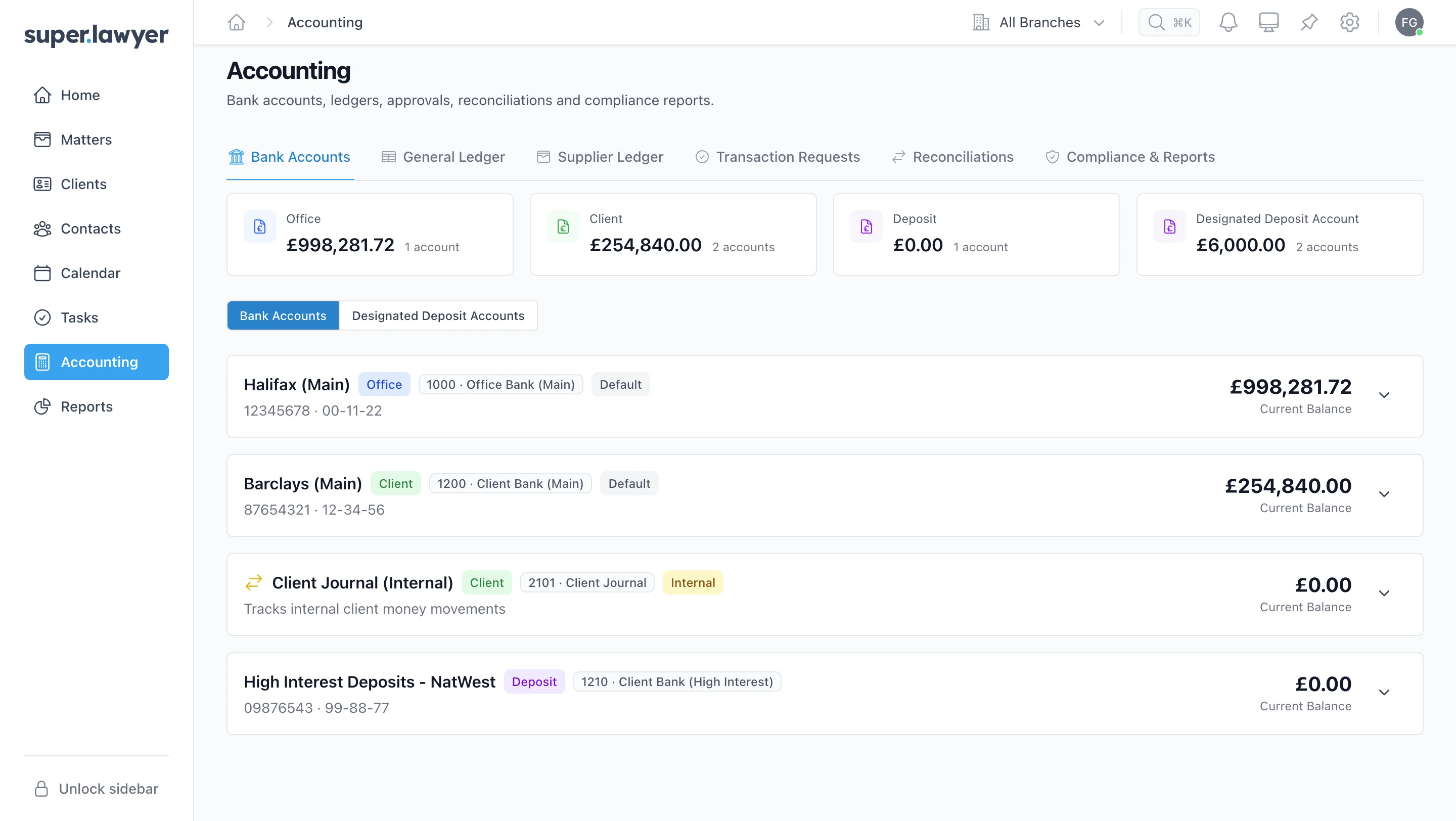
Keeping client money separate is a core requirement across legal accounts regimes. Superlawyer holds office, client, deposit and designated deposit accounts as distinct cash books, each with its account details, nominal ledger code and current balance - alongside internal client journals for money that moves without touching the bank.

  • Office, client, deposit and designated deposit cash books
  • Internal client journals for client money movements
  • Every account tied to its nominal code and current balance
The Superlawyer Bank Accounts area showing office, client, deposit and designated deposit cash books with nominal codes and current balances
Four kinds of money kept distinct, each cash book with its own code and balance
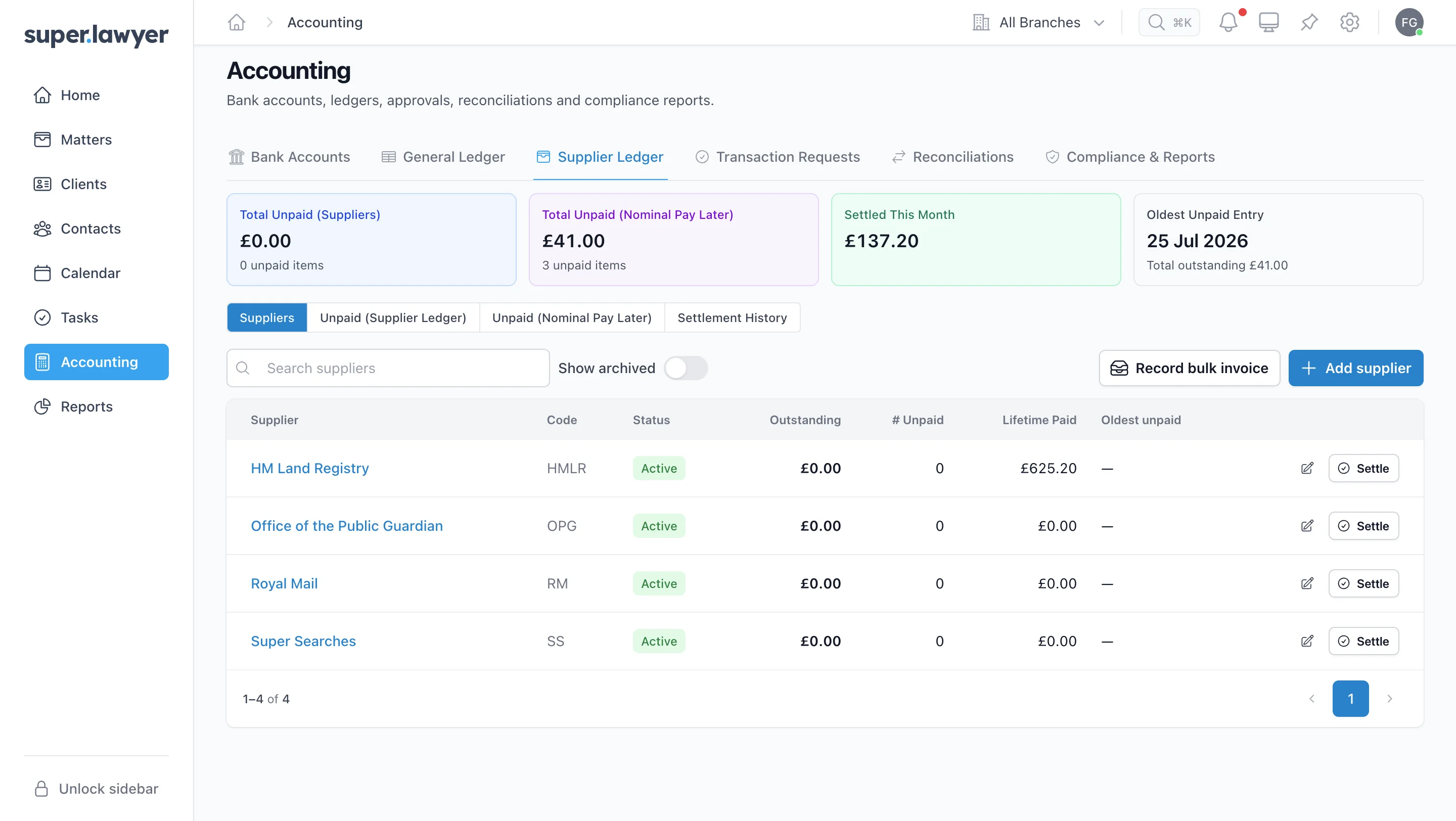
The Superlawyer supplier ledger showing suppliers, unpaid totals, settlement history and the wider accounting navigation
Supplier activity alongside the wider legal accounting workspace

Supplier ledger

Track suppliers, unpaid items and settlement history in one place

Manage supplier records alongside unpaid supplier-ledger and nominal pay-later items. See outstanding totals and record supplier invoices in bulk to different matters, then move directly into transaction requests, reconciliations or compliance reporting when the work requires it.

  • Supplier balances and bulk invoice recording
  • Unpaid items and settlement history together
  • Connected access to the wider accounting workspace

Reconciliation and sign-off

Make reconciliation accountable, then make it permanent

Prepare the reconciliation, tick each entry that appears on the real bank statement, and sign off. The signed record is permanent, with anything still outstanding documented on it - so the firm always knows who prepared, who signed and what was unpresented at the time.

  • Bank statement, cash book and client ledger compared in one view
  • Outstanding entries documented on the signed record
  • Signed reconciliations are permanent, with a cadence configured for your firm
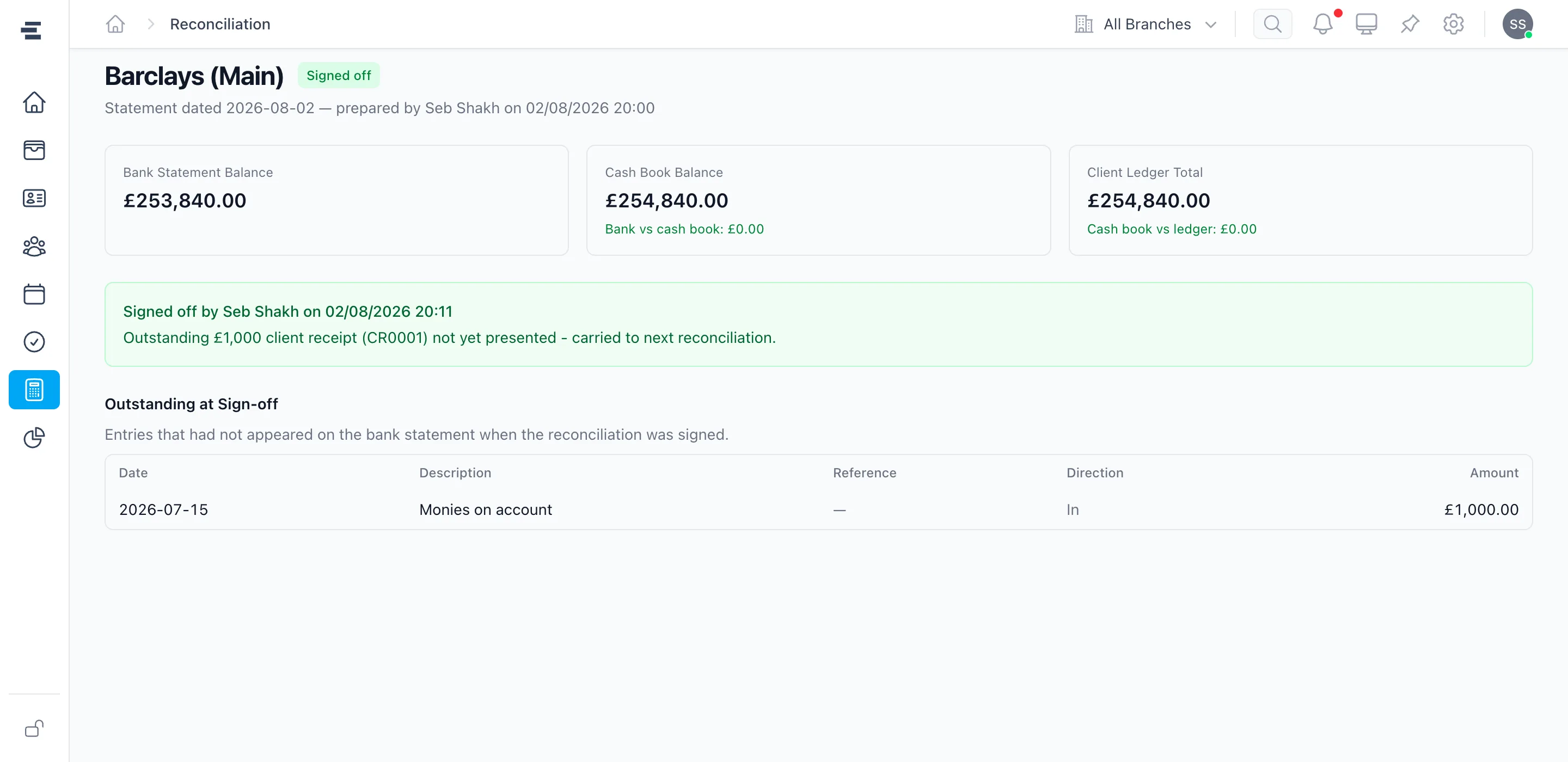
A signed-off client account reconciliation in Superlawyer: the cash book and client ledger match, and the bank statement is £1,000 lower because of one unpresented client receipt, documented as outstanding on the signed record
A signed reconciliation - the cash book and client ledger match, and the bank statement is £1,000 lower only because one client receipt hadn't reached the bank yet. That outstanding item is documented on the permanent record, so the position is fully evidenced.

Controls and compliance

An audit trail nothing can be deleted from

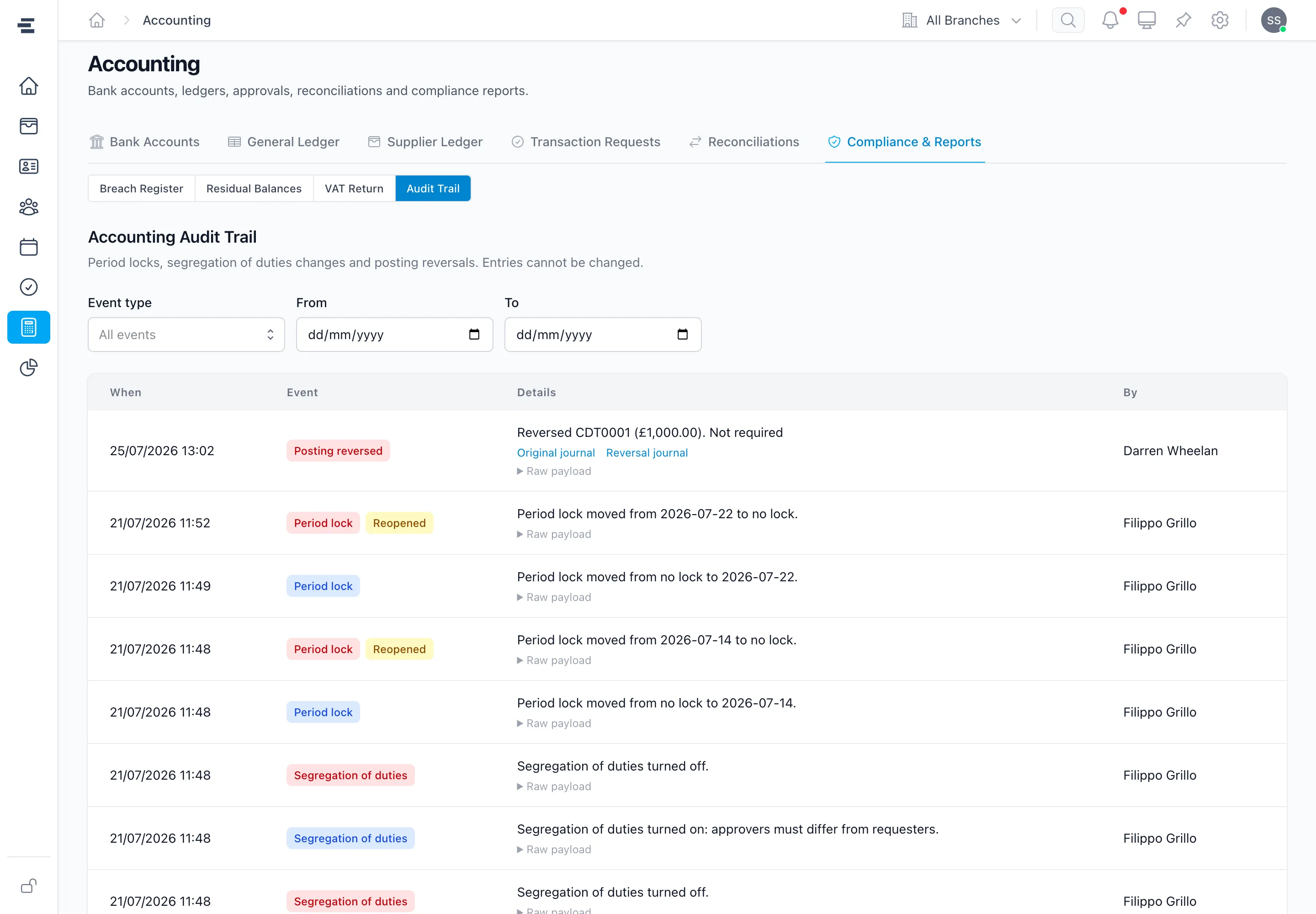
Transaction requests separate who asks for a payment from who approves it, accounting periods lock once reviewed, and every sensitive change - locks, reversals, segregation settings - is recorded permanently. The breach register, residual balance report and VAT return sit in the same compliance area.

  • Transaction approvals - approvers must differ from requesters
  • Period locking, with posting reversals recorded permanently
  • Breach register, residual balances and VAT return together
The Superlawyer accounting audit trail showing period locks, segregation of duties changes and a posting reversal, alongside the breach register, residual balances and VAT return tabs
Period locks, reversals and segregation changes on the permanent audit trail

A compliant rhythm

From posting to sign-off, without leaving the matter

Record, control, reconcile and review - with shared client money controls built into each step and support for regulator-specific requirements.

  1. Record against the matter

    Keep billing, ledger entries and transaction requests attached to the work they relate to.

  2. Apply your controls

    Use roles, permissions and approval processes that fit the firm.

  3. Reconcile and sign off

    Compare the bank statement, cash book and client ledger, then retain the permanent record.

  4. Review compliance

    Monitor breaches, residual balances, VAT returns and the audit trail from one area.

Frequently asked questions

The practical details

Clear answers to the questions private-client practices commonly ask before taking the next step.

Which regulators' accounts rules does Superlawyer support?

Superlawyer supports the shared controls required across the SRA, CLC and CILEx Regulation accounts regimes: client and office money kept apart, matter-level ledgers, regular three-way reconciliations, controls over who can move money and a permanent audit trail. Regulator-specific timings, responsibilities and reporting sit over those shared controls. Compliance stays your firm's responsibility - Superlawyer makes it easier to operate and evidence.

Does Superlawyer replace Xero?

Superlawyer handles the legal and client accounting workflow. The forthcoming Xero integration will send invoicing data and, for full legal accounting users, ledger entries into Xero for VAT reconciliation and Making Tax Digital filings.

What reconciliation and compliance records can Superlawyer retain?

Superlawyer retains prepared and signed-off bank reconciliation records and brings the breach register, residual balance reporting, VAT returns and audit trail into the same accounting area.

See Superlawyer in practice

Give your team a more connected way to work

Start with a quick guided demonstration, then explore Superlawyer in an assisted 14-day trial. No payment details are required.